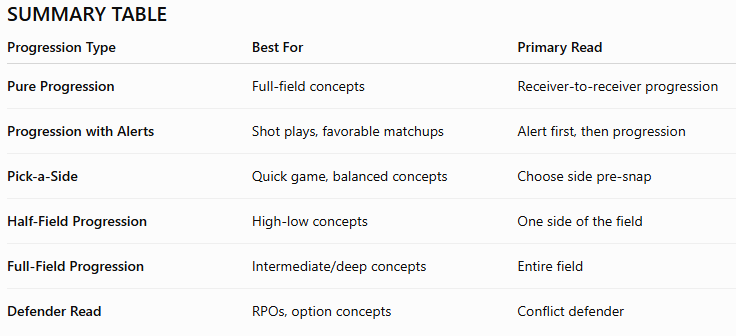
QUARTERBACK PROGRESSIONS
Understanding quarterback progressions is essential to executing the passing game. Every pass concept is designed with a progression that tells the quarterback where to begin, how to react to the defense, and where to go with the football if the initial read is unavailable. While every offense teaches progressions differently, most passing concepts fall into a few common progression types.
PURE PROGRESSION
A Pure Progression requires the quarterback to work through receivers in a predetermined order regardless of the defensive coverage. If the first read is unavailable, the quarterback immediately moves to the next option until a receiver becomes open or the checkdown is available.
The quarterback follows the progression exactly as it is designed.
Read 1 → Read 2 → Read 3 → Checkdown
Examples: Mesh, Y-Cross, Drive, Four Verts, Deep Crossing Concepts
Advantages
Simple and consistent.
Keeps the quarterback on schedule.
Easy to teach and repeat.
Disadvantages
Can be slower against disguised coverages.
May ignore favorable matchups elsewhere on the field.
PROGRESSION WITH ALERTS
An Alert Progression gives the quarterback an opportunity to take an explosive or favorable matchup before returning to the normal progression. If the alert isn't available immediately, the quarterback abandons it and works the concept as designed. The alert should never delay the timing of the play.
Alert → Progression 1 → Progression 2 → Checkdown
Common Alerts: Fade, Go Ball, Slot Fade, Back Shoulder, One-on-One Matchups, Blitz Indicators
Examples: Smash, Stick, Flood, Sail, Play Action, Shot Plays
Advantages
Creates explosive play opportunities.
Takes advantage of favorable leverage.
Punishes aggressive corners.
Disadvantages
Quarterback must quickly decide whether to take the alert.
Holding the alert too long disrupts the timing of the concept.
PICK-A-SIDE PROGRESSION (PRE-SNAP)
Some concepts allow the quarterback to choose which side of the field to work before the snap based on the defensive look. Rather than reading the entire field, the quarterback identifies the most favorable matchup or leverage and commits to that progression.
Before the snap, evaluate:
Safety shell
Corner leverage
Defender numbers
Blitz indicators
Receiver matchup
Once the decision is made, work the progression on that side.
Examples: Stick, Snag, Spacing, Double Slants, Quick Game, RPOs
Advantages
Speeds up decision-making.
Simplifies reads.
Ideal for quick game concepts.
Disadvantages
If the defense rotates after the snap, the quarterback must be prepared to adjust or throw the ball away.
HALF-FIELD PROGRESSION
The quarterback reads only one side of the field after the snap, usually by placing a defender in conflict with a high-low or triangle read.
Examples: Smash, Flood, Sail, China, Circus
Advantages
Faster decisions.
Simpler footwork.
Excellent against zone coverage.
FULL-FIELD PROGRESSION
The quarterback scans from one side of the field to the other, reading multiple route combinations until a receiver comes open.
Examples: Mesh, Four Verticals, Y-Cross, Drive
Advantages
Utilizes the entire field.
Handles a variety of coverages.
Maximizes route combinations.
DEFENDER READ (CONFLICT READ)
Instead of reading receivers, the quarterback reads a single defender. The defender's movement determines where the football goes.
Examples: RPOs, Zone Read, Bubble RPO, Glance, Y-Pop, Stick RPO
Advantages
Extremely efficient.
Forces one defender to be wrong.
Creates easy completions.
COMMON QB COACHING POINTS
✔ Stay disciplined with your eyes.
✔ Trust the progression.
✔ Don't predetermine throws.
✔ Let the defense tell you where to go with the football.
✔ If the progression breaks down, find the checkdown or create with your feet.